
Capital Optimization Through Pre-Owned Textile Machinery
Background
Technical and financial feasibility of sourcing used and reconditioned production lines
Introduction
Textile manufacturing is capital-intensive, with machinery accounting for up to 70% of total project investment. Capital optimization in the textile industry begins with the machinery decision. Sourcing pre-owned textile machinery allows manufacturers to establish or scale capacity at a fraction of the initial CAPEX.
New machinery is often the default choice. However, properly selected, technically verified and selectively refurbished used textile machinery can offer a much better Return on Capital Employed (ROCE) and a stronger textile machinery investment ROI.
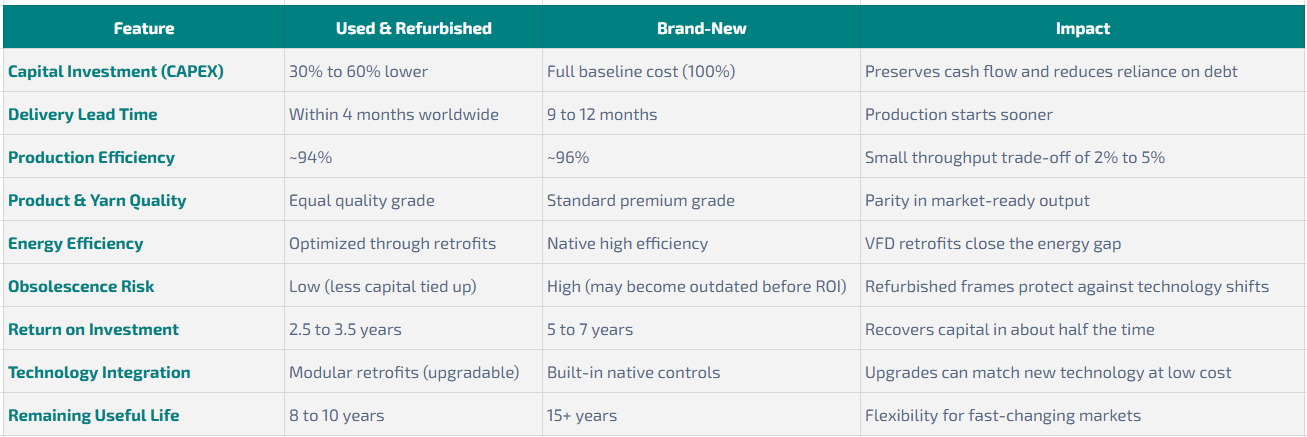
With targeted modernization, manufacturers can achieve near-identical product quality and keep the efficiency gap to a marginal 3% to 5% (for example, 94% actual efficiency against 96% for new machinery). At the same time, they can reduce initial capital expenditure by 30% to 60%.
The approach also shortens delivery. A 9 to 12-month wait for new machinery becomes a 4-month global deployment window, so production starts earlier and cash returns arrive sooner.
The approach to buying second-hand textile machines in five steps:
- Select the right machine
- Verify it technically
- Refurbish selectively
- Integrate upgrades
- Monitor KPIs continuously
Used and Refurbished vs. Brand-New Machinery
The real cost of bringing a machine online goes well beyond the invoice price. A useful measure for textile machinery investment ROI is the Total Project Investment:
Total Project Investment = Purchase Price + Dismantling/Transport + Installation + Refurbishment + Upgrades + Commissioning
Engineering Methodology: Quality, Efficiency and Energy Parity
A common belief among those considering used textile machinery is that older machine frames produce inferior output or consume more power. In practice, a machine's cast-iron frame does not decide yarn quality or energy use. Process settings, drive systems and component condition do. A targeted mechanical overhaul closes the gap to a very small margin.
1. Mechanical Component and Energy Restoration
- Precision bearing replacement: Replacing older main drive bearings with high-precision, low-friction units reduces vibration and energy drag, and lowers power consumption (kWh/kg).
- Drafting zone upgrades: Replacing worn cots, aprons and drafting rollers, and installing upgraded pressure arms, improves fiber guidance and reduces irregularities.
- Carding and wire calibration: Refurbishing high-wear carding wire and clothing maintains fiber parallelization and nep removal.
2. Process Optimization and Setting Calibration
Low output is rarely caused by a frame defect. It usually comes from process parameters that need tuning. These practices help sustain performance:
- Traveler optimization: Matching ring traveler weight and profile to the target yarn count reduces end breakages.
- Spindle alignment: Laser re-leveling and reinforcing spindles removes eccentric rotation that causes tension spikes.
- Pneumatic stabilization: Clearing and sealing suction channels gives uniform air pressure along the frame.
- Continuous improvement cycle: Measure key KPIs → Analyze variances → Correct process settings → Standardize procedures → Monitor continuously
The Upgrade Advantage and the Obsolescence Trap
Textile technology keeps advancing, with new digital and mechanical designs arriving every few years. This creates a strategic risk for buyers of new machinery.
The Brand-New Obsolescence Trap
A new machine needs a high capital commitment and takes 5 to 7 years to reach ROI. Because technology cycles are short, it may become dated before it has paid for itself. The result is a high-CAPEX, depreciating asset that struggles to compete with the next generation of equipment.
The Refurbished Upgradability Model
The structural frames of textile machines do not change fundamentally, so older machines can be retrofitted to match newer technology. Instead of paying for integrated native controls, a legacy frame can be turned into an intelligent, energy-saving unit through modular retrofitting:
- Variable Frequency Drives (VFDs): Fitted to the main drive motors, VFDs allow precise speed curves matched to the yarn's stress limits. This brings significant energy savings and fewer breaks.
- Individual spindle monitoring: Optoelectronic break-detection sensors alert operators to failures instantly. This lowers Mean Time to Repair (MTTR) and helps hold line efficiency at about 94%.
- Online tension and quality sensors: Real-time yarn clearers and digital tension monitoring track mass variation (U%) and imperfections (IPI), so defective output is caught early and quality matches new units.
- Vibration and temperature monitoring: Supports predictive maintenance.
Regional Proof of Concept: The Asian Hub Model
Using refurbished machinery to stay competitive is an established model in leading textile hubs. In India, Bangladesh, Indonesia and Thailand, many manufacturers have scaled up with pre-owned textile machinery and modernized lines. By avoiding heavy debt and putting assets to work quickly, these mills have stayed competitive against high-CAPEX alternatives. They expand when the market peaks and retrofit their lines as new technologies emerge. This is capital optimization in the textile industry in practice.
Energy Cost Optimization: The VFD Retrofit
This model shows the financial impact of VFD retrofits on a spinning section.
Baseline parameters
- Production unit: 10-frame spinning section (approx. 10,000 spindles)
- Motor rating: 45 kW standard induction motor per frame
- Total connected load: 45 kW × 10 frames = 450 kW
- Operating schedule: 24 hours/day, 350 days/year (8,400 hours/year)
- Industrial energy tariff: $0.090 per kWh
- Average load factor: falls from 85% to 65% after the VFD retrofit, due to automated speed profiling
Annual savings model
- Consumption without VFD: 450 kW × 0.85 × 8,400 hours = 3,213,000 kWh
- Consumption with VFD: 450 kW × 0.65 × 8,400 hours = 2,457,000 kWh
- Net annual energy savings: 3,213,000 − 2,457,000 = 756,000 kWh
Financial impact
- Annual electricity savings: $68,040
- VFD retrofit cost (10 frames): $15,000 (one-time)
- Payback period: about 2.6 months
Time-to-Market and Earlier ROI Breakeven
New lines typically take 9 to 12 months to manufacture and deliver. Once an expansion is approved, every month of waiting means lost revenue and idle facility overhead. Buying second-hand textile machines avoids much of this delay.
Accelerated 16-week global roadmap
- Weeks 1–2: Dismantling and match-marking. Mechanical strip-down, anti-rust coating and tagging of all gear assemblies by certified riggers, so reassembly is accurate.
- Weeks 3–9: Global transit and customs. Inland freight, port handling, ocean transit and fast-track customs clearance, with delivery to a secure warehouse next to the mill.
- Weeks 9–12: Civil work, facility preparation and installation. Anti-vibration machine pads, main electrical lines and pneumatic drops built to pre-engineered CAD layouts. This is followed by uncrating, chassis leveling, re-mounting of shafts and spindles, and laser alignment of the main drafting drives.
- Weeks 12–13: Electrical controls and VFD retrofitting. New wiring harnesses, upgraded PLC cabinets and programming of the motor speed curves.
- Weeks 14–15: Calibration, trial runs and material audits. Dry runs to test emergency cut-offs, then wet trials to fine-tune the drafting zones and confirm commercial-grade output.
- Week 16 onward: Commercial go-live. Handover to trained shift operators for continuous production at the 90–94% target efficiency.
Conclusion
The choice between new and pre-owned machinery depends on balancing capital availability against the required payback period and the expected textile machinery investment ROI. New machinery is best suited where maximum automation and a 15+ year operating horizon are essential.
For capacity expansions in standard product segments, used textile machinery that is modernized and refurbished is a strong use of capital. It delivers market-grade quality and competitive throughput (~94% efficiency) with a 30% to 60% CAPEX saving. It also reduces exposure to technological obsolescence and delivers functional assets within 4 months, compared with 9 to 12 months for new machinery.
Combined with energy-saving retrofits such as VFDs, and supported by long industrial experience in India, Bangladesh, Indonesia and Thailand, this approach offers a quick return on investment. It improves the project's Net Present Value (NPV), reduces reliance on debt and shortens the path to profitability, making it a practical route to capital optimization in the textile industry