
Driving Excellence and Delivering Measurable Results in a Spinning Unit
Introduction
- A large spinning unit engaged Texcoms to implement an Operational Excellence program across its operations over a period of 6 months. With a capacity of 51,840 spindles producing 100% polyester yarn, the unit sought to address inefficiencies, improve product consistency, and establish sustainable systems.
- The collaboration focused on achieving measurable improvements in productivity, quality, cost-efficiency, and equipment utilization through a structured, data-driven approach.
Problem Statement
The spinning unit was facing several operational challenges that hindered overall efficiency and profitability:
- Inconsistent productivity levels across departments.
- High levels of production waste and energy consumption.
- Variations in yarn quality parameters.
- Absence of standardized operating procedures (SOPs).
- Skill gaps among operational staff and technicians.
- Reactive maintenance practices affecting equipment uptime.
Action Taken
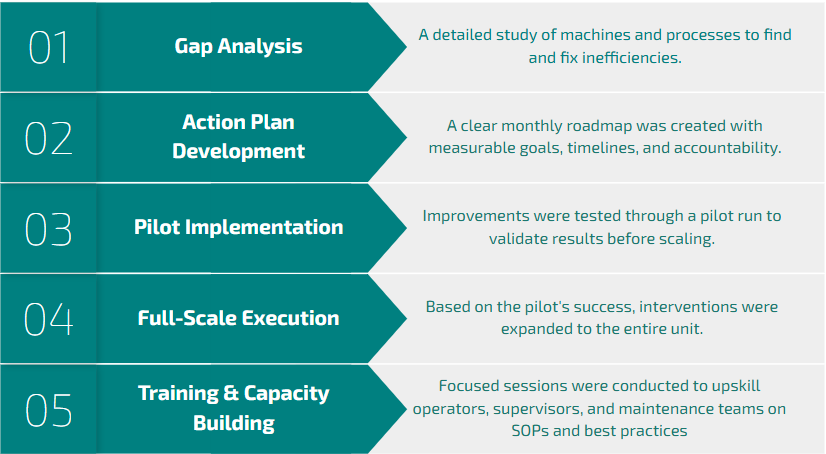
Key Interventions and Operational Enhancements
Mixing SOP & Training
- Soft wastecut before mixing.
- Team trained to follow SOP for soft waste use.
Simplex & Roving Tension Control
- Tension control improved
- Lower creel tension
- Worn-out aprons replaced
- Flyer cleaned regularly
- Piecing reduced with batch creeling
- Better piecing method adopted
Blowroom System Optimization
- Consistent feed through Unimix.
- Smaller tuft size from bale plucker.
- Suction pressure adjusted properly.
- Heavy particle separator SOP applied.
Ring Frame Productivity Boost
- Spindle speed optimized
- SOPs followed for piecing and patrol
- Faulty spindles and lashing fixed
- Drafting and other key areas cleaned
Carding Improvements
- Machine settingscorrected.
- Suction and delivery tuned.
- Damaged parts replaced.
- Coiler cleaning improved.
- Faulty cards fixed.
- Sliver thickness issues corrected.
Link Coner & Quality Monitoring
- Highcuts traced andfixed.
- Bobbin rejection issue corrected.
- Tension and speed fine-tuned.
- Reduced variation between drums.
Draw Frame Enhancements
- Suction pressureadjusted.
- Better sliver joining and batch creeling.
- Cleaning improved in draft zone.
- Hooter cleaning organized.
- Process settings made consistent.
Sustainability & Standardization
- SOPs standardized across units
- Cleanliness routines followed
- Fixed cleaning schedule for key machines
- Regular training for staff
- Machine settings made consistent
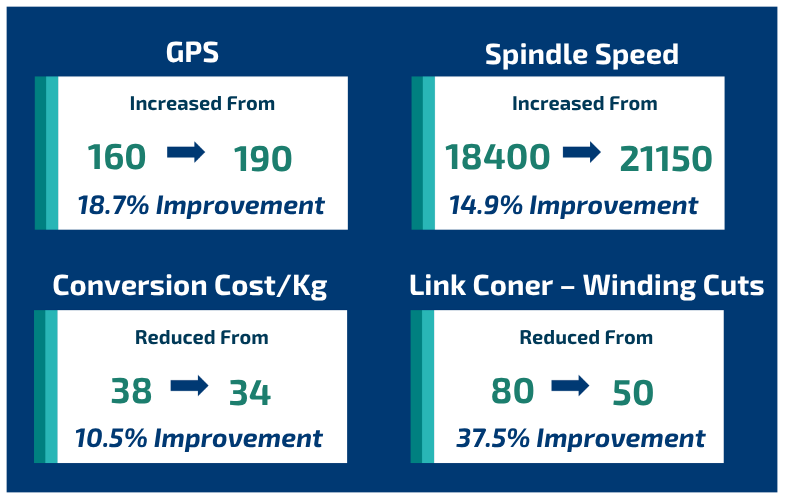
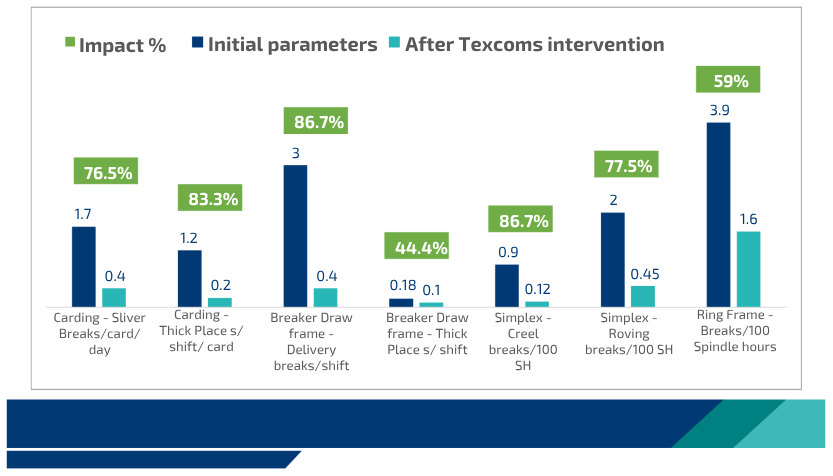
Key Milestones
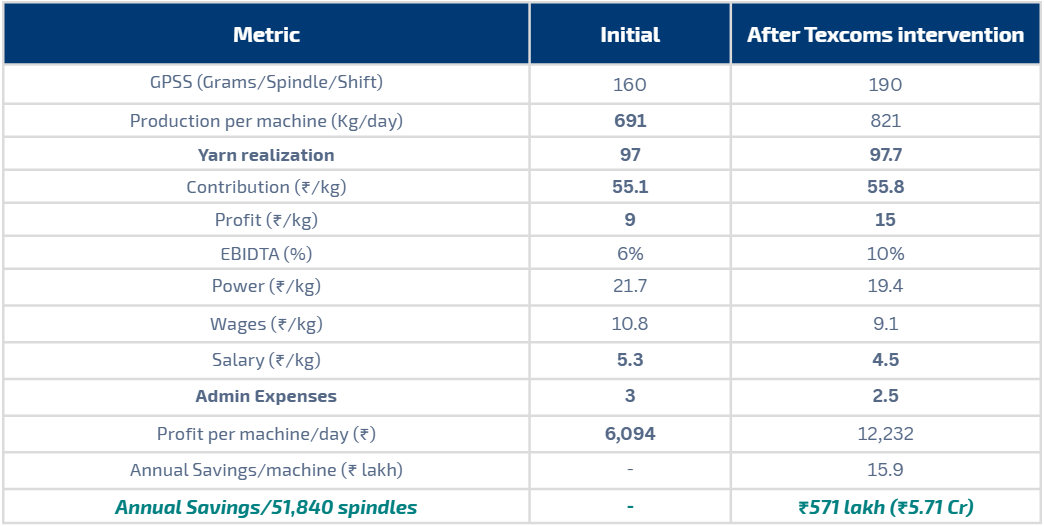
Cost Impact - The Numbers Behind the Transformation
- Unit Profile: 51,840 Spindles.
- Average Count: 40s (100% PSF).
Conclusion
In today's cost-sensitive environment, Texcoms demonstrates thatOperational Excellence is not a one-time fix, but a long-termcommitment to profitability, quality, and sustainability. With deep expertise in machine optimization, process improvement, and operational support, Texcoms enabled the factory to achieve substantial gains in efficiency and product quality-setting new benchmarks in spinning performance.
Talk to our consultants to learn how Texcoms can drive similar results for your organisation.