
Healthy Assets, Profitable Operations: A Spinning Unit Case Study
In a spinning unit, machines are not merely production tools; they are value-creating assets. Yarn quality, productivity, energy consumption, and delivery reliability are all direct outcomes of machine health. This case study illustrates how a disciplined maintenance system transformed asset performance and improved overall profitability in a spinning mill.
Background
The unit was equipped with modern spinning machinery, yet it faced recurring issues such as frequent breakdowns, quality variations, and rising maintenance costs. Despite skilled manpower, performance was inconsistent across machines and departments. Detailed analysis revealed that most failures were not due to machine design limitations but due to weak systems—particularly poor cleaning, lubrication lapses, and lack of preventive discipline.
This led to a fundamental shift in thinking:
Machines do not fail on their own; systems fail when discipline is missing.
Maintenance Strategy and Execution
The first major intervention was a shift from reactive breakdown maintenance to a structured planned maintenance approach. Daily and weekly routine maintenance activities such as cleaning, lubrication, tightening, and inspection were standardized using machine-wise checklists. Preventive maintenance schedules were introduced based on time, running hours, and condition monitoring, ensuring that wear parts were replaced before failure.
Predictive maintenance practices were strengthened by monitoring vibration, temperature, noise, suction pressure, and motor load. These early warning indicators allowed maintenance teams to plan interventions in advance, reducing emergency stoppages and spare wastage.
A key cultural change was assigning clear ownership of machine health. Foremen were made accountable as asset owners, responsible not only for production output but also for machine condition, preventive maintenance compliance, and repeat failure elimination. This approach eliminated shortcut maintenance and ensured that standards were followed consistently. Manager Model Machines are implemented for continuous improvement
Asset Ownership and Work Discipline
Strong emphasis was placed on SOP adherence, correct tool usage, precise setting and service room discipline. Tools were calibrated, organized through 5S practices, and used only for their intended purpose. This improved maintenance quality and reduced secondary defects caused by improper repairs.
Quality Improvement through Root Cause Analysis
Recurring quality issues, such as high sliver thick spots, were addressed through structured root cause analysis. Investigations identified suction leakage, worn clothing, inaccuracy in critical setting ,worn out consumables and inconsistent stripping practices as primary causes. Corrective actions included suction standardization as per OEM norms, disciplined stripping schedules, replacement as per OEM recommendations , Using OEM spares and stricter routine & preventive maintenance execution.
These measures resulted in a marked reduction in yarn defects, improved consistency, and better downstream performance in subsequent processes.
5S anOperator Involvementd
Combined with strong 5S implementation, this improved housekeeping, safety, and early fault detection. Clean machines became easier to monitor, enabling timely corrective action and reducing hidden losses.
Performance Measurement and Results
Maintenance performance was tracked using key indicators such as breakdown frequency, MTBF (Mean Time Between Failures), MTTR (Mean Time To Repair), maintenance cost per kilogram of yarn, and mechanical quality defects. Regular reviews ensured accountability and continuous improvement.
As a result, the unit achieved higher machine availability, stable yarn quality, reduced breakdowns, controlled maintenance costs, improved safety, and enhanced customer satisfaction. Most importantly, maintenance shifted from being perceived as a cost to being recognized as a profitability driver.
Conclusion
This case study demonstrates that disciplined maintenance systems, strong ownership, and focus on fundamentals can significantly improve spinning mill performance. Healthy assets ensure stable operations, consistent quality, and sustainable profitability.
Case study in 50000 spindles in Count Ne 40s Combed:
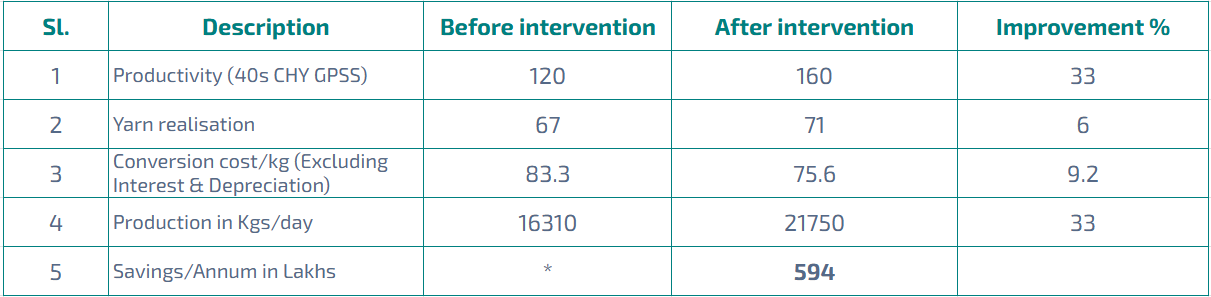
Good maintenance runs silently, but its impact on profitability speaks loudly.